
Exploring the dark web and deep…
Mark T.’s ATM Scheme: A 72-Hour Journey to Capture and Consequences
Mark T., a 34-year-old resident of Tampa Bay, purchased six cloned cards for $480 in cryptocurrency, netting $4,200 before federal arrest.
Date: — Checked: Oct 15, 2026

When exploring the dark web and deep web for users seeking information on hidden resources and online privacy, you might encounter marketplaces offering seemingly easy illegal profits. Understanding how investigators trace these transactions helps you recognise the severe real-world risks involved. Let us examine how a brief cybercrime spree unraveled within seventy-two hours and resulted in a five-year federal prison sentence.
Imagine you decide to purchase illicit banking data online, trusting that privacy coins will shield your identity completely. You will soon discover that physical cash-out points bridge the gap between hidden digital networks and law enforcement jurisdiction. Carefully examine the mechanics of financial tracking, carding forums dark web activity, and the physical vulnerabilities that inevitably expose perpetrators.
The website where the purchase was made operated entirely behind hidden network protocols.
- Examine the Mechanics of Financial Fraud
Grasping the intricacies of transforming illicitly acquired banking details into legitimate cash can be quite challenging. You should recognise that the carding process consists of several key stages, all crafted to exploit compromised accounts before financial institutions can identify any issues.
Data Collection: Criminals gather magnetic stripe information from two tracks through various techniques, such as hidden devices, phishing, or purchasing from illicit online marketplaces.
Card Production: The obtained data is imprinted on blank plastic cards, which include forged names, expiration dates, and account details, thus creating the appearance of authentic banking cards.
PIN Acquisition: Important personal identification numbers are secured using overlay keypads or covert cameras set up at cash machines.
Fund Withdrawal: The fraudster promptly withdraws cash from ATMs before the original account owner becomes aware of the fraudulent activity and triggers a card block.
Money Laundering: The cash is transformed into digital currencies through peer-to-peer platforms or specialised cryptocurrency kiosks, thereby effectively concealing the monetary trail.
Imagine a scenario where you have secretly obtained banking details. You might think that the operation is completely secure. In November 2024, for $480 in Monero, six cloned debit cards, complete with their PINs, were obtained by Mark T. from a darknet marketplace. The package was delivered to his home in unmarked packaging, and the site used for this transaction operated on concealed network protocols. Examining images of ATM skimmers shows how these devices are cleverly integrated into public machines. Operators utilize various methods, including tools designed to detect skimming devices, to find vulnerabilities. It may be prudent to consider protective measures against skimming when evaluating terminals. Numerous users actively discuss cloned cards or similar strategies on platforms like Reddit to enhance their understanding of these operations. Cybersecurity professionals often engage in discussions about protective measures and devices related to card skimming across different forums. You might question how to identify if a card reader has been compromised or how to detect a skimmer; it is crucial to look for loose bezels, mismatched keypad colors, and unfamiliar attachments. In his initial attempts, Mark withdrew $4,200 from the first three ATMs. However, he could not proceed with his activities at the fourth terminal. Each phase of this complex operation leaves both digital and physical traces that skilled investigators can use to piece together the timeline of events.
- Analyze the Hidden Surveillance Vulnerabilities at Cash Terminals
Why do perpetrators consistently underestimate the surveillance capabilities of modern automated teller machines? You must recognise that these public cash dispensers function as comprehensive evidence collection systems rather than simple money delivery boxes.
Imagine walking up to a street-corner terminal under the cover of night, believing nobody is watching. You insert the plastic, input the code, and collect the cash. Inside almost every modern machine, multiple surveillance and logging mechanisms operate continuously:
Built-in camera: Positioned directly to capture the client's face in high resolution, often featuring infrared illumination to support clear recording during dark hours.
Hidden camera: Many models integrate a secondary optical recording unit at an alternative angle, completely invisible to casual external inspection.
Transaction log: Every single interaction is cataloged with absolute precision down to the second, recording exact timestamps, requested amounts, account identifiers, and terminal numbers.
Geolocation: The hardware maintains fixed coordinate data and transmits operational telemetry directly to the central banking servers.
Network log: Communication packets exchanged with the primary processor retain detailed connection metadata and routing details.
When Mark approached the fourth terminal in a Tampa Bay suburb, the primary built-in camera recorded his unmasked face in sharp profile. He wore no hat, no glasses, and no facial covering. He extracted $700, retrieved the card, and departed. That twenty-three-second video recording sealed his fate. Criminals frequently assume that darknet anonymity shields them in the physical world. Yet, a cash terminal is never a hidden network node. It represents the exact physical boundary where digital crime materializes into tangible reality, bringing absolute finality to any perceived anonymity.
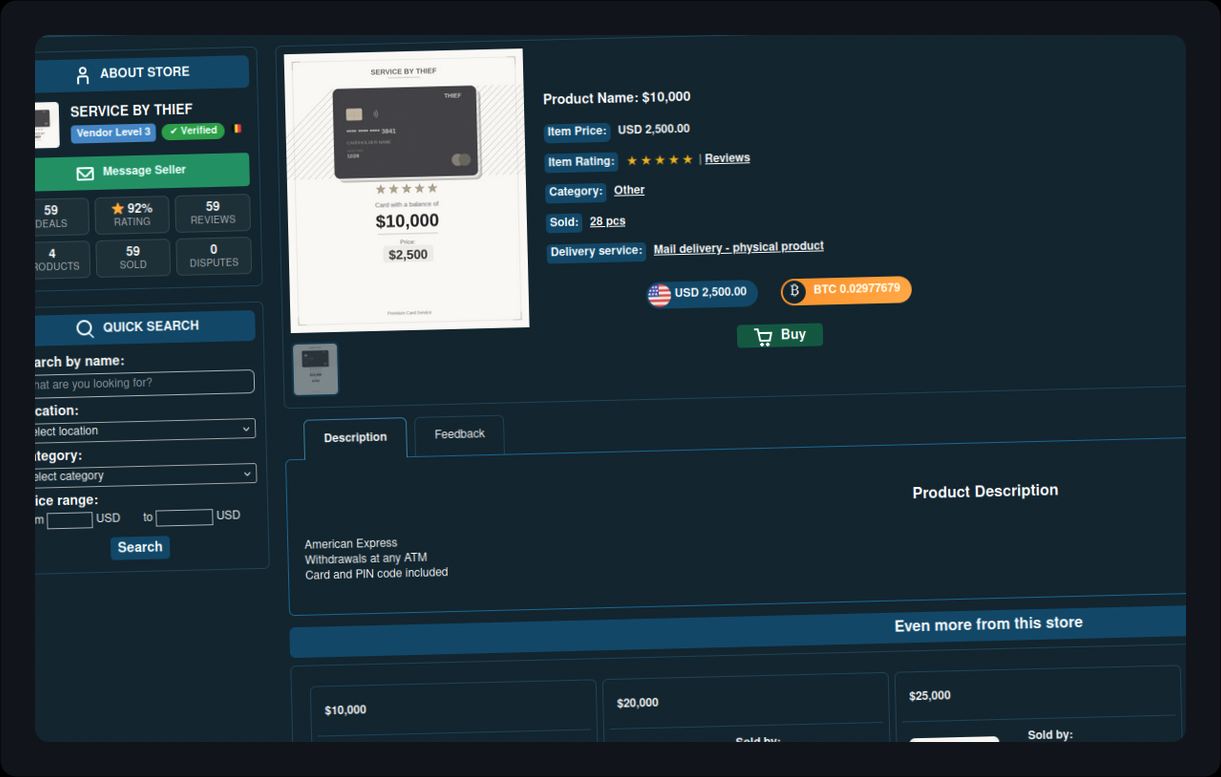
A storefront interface displaying illicit financial product listings. - Trace the Chronological Investigation Timeline
How quickly can authorities and financial institutions dismantle a carding scheme? It may be surprising to learn that the integration of sophisticated automated fraud detection systems and partnerships with federal agencies can swiftly uncover irregularities and apprehend offenders.
Examining how minor banking alerts rapidly evolve into major federal investigations reveals the chronological progression of Mark T.'s apprehension, outlined below:
Chronological Phase Event Description Principal Participants On Day 1, unauthorised withdrawals are reported to banks by multiple individuals from Florida, Georgia, and North Carolina. Day 3 Fraud detection systems identify unusual withdrawal activity and activate emergency security measures Banking Fraud Prevention Systems Day 5 The investigation is escalated to the United States Secret Service for further inquiry Banking Analysts, USSS Day 8 CCTV footage reveals a suspect's likeness; a comparison with state driver databases confirms the identity of Mark T. USSS, State Department of Public Safety Database On Day 12, warrants were obtained by investigators to scrutinise electronic traces, including activities related to browser history, internet service provider records, and cryptocurrency wallets. Day 14 A search warrant is executed; law enforcement seizes blank cards, a magnetic stripe writer, and cash Local Law Enforcement, USSS Day 15 Mark T. is arrested and admits to acquiring and cashing out four fraudulent cards Federal Agents, Suspect Imagine attempting to hide illicit actions by spreading transactions across multiple states. Automated scoring systems can quickly highlight such anomalies. The issue was escalated to the United States Secret Service by the bank, recognising the seriousness of the situation, as this federal agency handles investigations into financial crimes. Transaction records and surveillance images were requested by an analyst to aid in the investigation. By cross-referencing the footage with the state's driver license database, Mark T. was promptly identified, despite a clean criminal record. It was confirmed by further investigations that within a 40-mile radius of his home, all four withdrawal events took place. Electronic warrants linked his online activity to Tor exit nodes during specific times of his marketplace transactions. A judicial order directed at the cryptocurrency exchange connected his Monero transactions to his verified identity. Upon executing the search warrant at his residence, authorities discovered six blank plastic cards, a magnetic stripe writer, a laptop with evidence of Tor Browser activity, $3,200 in cash, and original shipping materials. In follow-up interrogations, a confession emerged from him regarding the acquisition of these cards, revealing that four had been successfully cashed out, whereas the banks had pre-emptively blocked the other two, rendering them unusable.
- Evaluate Why Privacy Cryptocurrencies Fail to Protect Perpetrators
Why did privacy-focused cryptographic assets fail to protect Mark from federal prosecution? You must understand that absolute anonymity collapses at the specific points where digital networks intersect with the regulated physical economy.
Imagine utilizing a coin specifically engineered for untraceable transfers, believing your financial footprint is entirely invisible. You will soon realize that intermediary conversion points and physical evidence create undeniable links. Consider the primary vulnerabilities that bypassed cryptographic protection in this case:
The acquisition gateway. To purchase privacy coins initially, Mark utilized a centralized exchange where he completed strict identity verification procedures, uploading his passport and a biometric selfie. When the court issued a legal order, that exchange surrendered his complete identity profile and transactional history. Although the subsequent movement of the digital asset across the blockchain network remains complex to trace, the definitive proof of purchase matching the exact date and amount served as compelling circumstantial evidence.
The temporal correlation. The entire sequence—acquiring the digital asset, purchasing the illegal goods on the marketplace, receiving the parcel in the mail, and executing terminal withdrawals—occurred within a compressed two-week window. This tight timeframe eliminated plausible deniability.
Physical artifacts. The blank cards and magnetic writers discovered inside his residence contained encoded tracks that matched the exact data stolen from real victims. No digital token can wash away direct physical evidence.
Visual identification. A recorded face on a surveillance camera cannot be laundered through blockchain mixing services. Even if every digital trace had been impeccably scrubbed, the video footage alone definitively placed the suspect at the crime scenes.
- Review the Operational Mistakes That Caused Immediate Detection
What specific operational errors guarantee that an amateur card user will be identified swiftly? You will discover that criminal investigations succeed because perpetrators repeatedly violate fundamental security principles during execution.
Suppose you execute financial transactions without proper preparation or tactical awareness. You will inevitably leave a trail that automated systems and human investigators can follow. Review the critical missteps committed during this criminal enterprise:
Geographic concentration: Executing all cash extractions within a tight forty-mile radius around a permanent home address triggers instant anomaly alerts within banking security algorithms.
Complete lack of concealment: Operating in public view without masks, hats, or glasses ensures that surveillance optics capture high-definition facial data matching government identification records.
KYC exposure: Purchasing privacy coins through standard centralized exchanges ties real-world identity directly to the digital funds used on illicit marketplaces.
Retaining physical evidence: Storing blank cards, magnetic encoding hardware, and laptops with browser remnants at a primary residence provides undeniable material proof during a search.
Accumulating cash denominations: Keeping physical currency at home that matches the precise bills dispensed by targeted cash terminals strengthens the prosecution's case.
Excessive operational speed: Compressing all extractions into a brief two-week period maximizes the likelihood that anti-fraud systems will flag the activity immediately.
Had the perpetrator spaced his attempts over many months, automated triggers might have reacted more slowly, but surveillance optics would still have captured his likeness. Digital remnants survive standard deletion efforts; browser caches leave traces, and operating system update logs reveal software usage timelines.
- Examine Institutional Lessons and the Final Judicial Outcome
What key lessons can cybersecurity experts extract from this federal case? It is essential to understand that contemporary financial safeguards depend on a sophisticated blend of automated digital protocols alongside traditional physical investigative methods.
Imagine how institutional security systems function discreetly to safeguard financial frameworks. Here are significant insights gained from this case:
Automated fraud prevention mechanisms serve as the foremost and most effective barrier. Cutting-edge pattern detection, rigorous geolocation protocols, and machine learning evaluation models react instantaneously, often before human involvement is needed. Financial institutions must persist in allocating resources towards enhancing anomaly detection techniques.
The integration of physical and digital forensics is essential. While surveillance footage provides undeniable visual proof, transaction records deliver the timestamps needed to identify those exact moments. Combining these two investigative domains establishes a robust foundation for contemporary casework.
The notion of complete anonymity is misleading. Gateways that necessitate identity verification and cash withdrawal points create unavoidable links connecting virtual actions to tangible realities.
Educating customers is essential. Individuals who postpone reporting fraudulent activities give criminals extra time to siphon off funds. Swift alert systems enable institutions to freeze compromised accounts more quickly, thus mitigating overall financial losses.
In relation to charges of fraud and activities linked to access devices specified under 18 U.S.C. § 1029, as well as allegations of money laundering under 18 U.S.C. § 1957, a guilty plea was entered by Mark T. in March 2025. A sentence of sixty months in federal incarceration, followed by a three-year period of supervised release, was imposed on the defendant by the presiding judge. In addition, the court levied a fine of $22,000 and mandated full restitution to the three identified victims. During the sentencing, the judge highlighted that although Mark was merely the final link in the consumer chain rather than the principal orchestrator, this last link bears the physical consequences and penalties. The individuals who truly engineer such schemes often remain hidden, posing a persistent challenge for law enforcement agencies.
Reflect on the Reality of Digital Crime Consequences
Mark's brief venture into financial crime demonstrates that the intersection of automated banking telemetry, high-definition terminal surveillance, and federal investigative reach makes prolonged evasion nearly impossible for individual operators. You must acknowledge that hidden network anonymity offers zero protection once a crime manifests in the physical world. Prudence and awareness remain your strongest safeguards against online deception.
FAQ
How long did it take investigators to identify the perpetrator after the initial bank reports?
Investigators matched surveillance footage to state driver databases and identified Mark T. within eight days of the initial bank fraud complaints.
Why did privacy-focused cryptocurrency fail to keep the transaction anonymous?
The purchase of Monero through a centralized exchange requiring identity verification linked the suspect's real-world identity to the digital funds used on the marketplace.
What specific federal charges resulted in the final prison sentence?
The defendant pleaded guilty to access device fraud under 18 U.S.C. § 1029 and money laundering under 18 U.S.C. § 1957, receiving sixty months in prison.
Sources
Further services
We keep a short list of services we check regularly. Resources.
Worth a look

Dark Web Hidden Wiki Reddit
Discover the Dark Web Hidden Wiki on Reddit, a valuable resource for finding links to hidden services and information on online privacy.
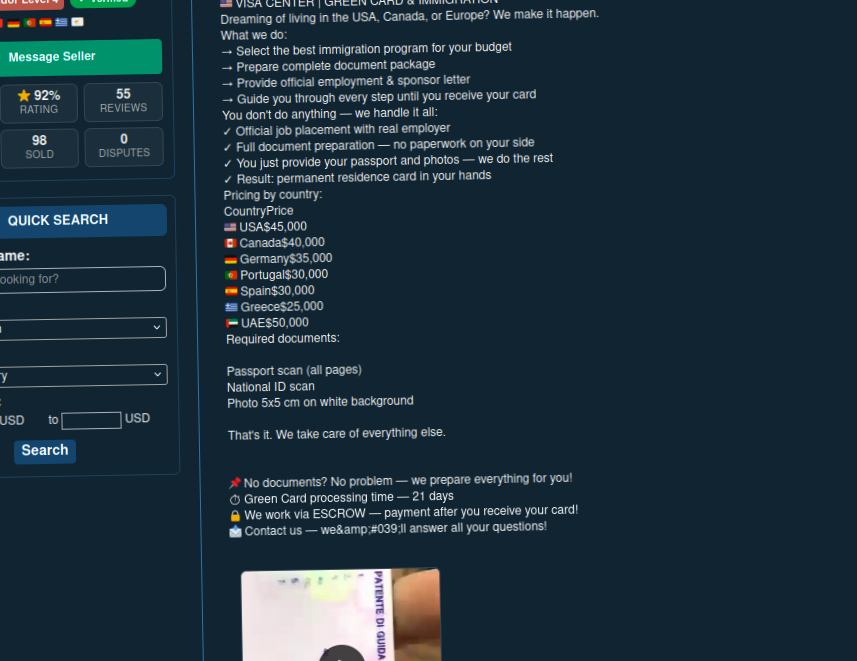
The Dark Side of Passport Sales: Navigating Online Scams
Explore the stark contrast between advertised dark web passport prices and actual costs in the black market.